The first advertisement highlights three aspects: waterproofness, battery life of 30 hours, and noise cancellation. In the second advertisement, a female runner is featured who gets caught in a downpour, but her headphones keep on playing her favourite songs throughout the sudden storm that she endures in the last stretch of her race.
Both ads convey similar information, but only one of them evokes some feelings and emotions. This presents the reason why storytelling is more effective because it creates a major difference as well as makes one feel something. Thus, it is necessary to analyse the essence.
The problem with selling
Traditionally sales messages are organised in terms of products their features, advantages and cost. Direct as this approach is, it is still very easy to ignore since people have become used to ignoring overt sells. People have developed immunity to advertising: as soon as you feel that you are being sold something, your defences become activated, and you stop paying attention.
Selling asks for a decision before being able to build any trust. Storytelling builds trust first, and then the decision comes.
What separates a story from a pitch
Not everything that has a beginning, middle, and end is effective marketing storytelling. The most effective brand stories display a number of characteristics:
An identifiable protagonist. The best stories should be about the person, not the company. Companies must not be portrayed as heroes in the story.
Real conflict. Every story has to have a conflict; otherwise, it isn’t a story, it is just a description. Conflict must represent an actual need or desire of the audience.
An honest resolution. The company must solve the problem for the customer in the end – this should not be a sales gimmick.
Specificity. General stories do not resonate well with the audience. The specifics that seem almost too personal in order to be about anybody will usually resonate with everyone.
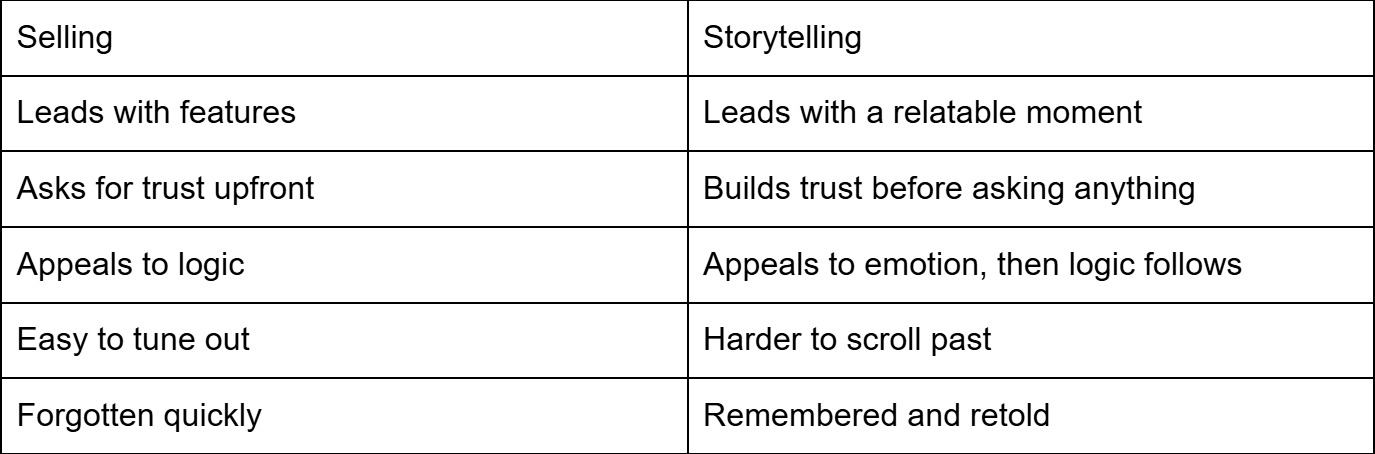
Storytelling versus selling, side by side
It is not debatable that facts are going to be important at some stage of the buying journey. However, facts should only come into play after the story has been told.
How to apply this without overcomplicating it
You do not necessarily have to have a high budget in order to convey a good story. In fact, sometimes basic stories are better:
Use of consumer stories rather than brand claims. Instead of claiming your service is reliable, tell the story about one particular customer who needed a reliable service and whose wants were satisfied.
Story of the origin with a real “why”. Market audience can be easily attracted by founders and teams who started something because of some problem or gap they noticed.
Use of the “before and after” technique. Show the audience how life was before your product and how it changed after it.
Establish a situation in which the same storyline is being used in all campaigns.
The bottom line
Sales is convincing others about a certain statement or proposition. Telling stories leads to receiving an emotional experience, and those feelings will be discounted by the audience. In these cynical times, companies that tell stories will be successful and be in leading positions in their field because the audience appreciates such methods.
While the features are still important, they should be mentioned as the second stage of the process, not as the first.